Suffield’s Main Street is lined with homes that predate electricity, let alone modern paint chemistry. The town was settled in 1670 and incorporated in 1682, and its historic district — a roughly 235-acre stretch of North and South Main Street added to the National Register of Historic Places in 1979 — is home to colonial, Greek Revival, and Late Victorian houses built across the 18th and 19th centuries. That history is part of what makes Suffield special, but it also means many local homes fall under federal lead paint regulations that homeowners often don’t learn about until they’re planning a paint job.
Why This Applies to So Many Suffield Homes
The relevant cutoff isn’t the historic district specifically — it’s 1978, the year the United States banned lead-based residential paint. Any home built before that date is legally assumed to contain lead-based paint unless testing proves otherwise, according to the EPA. In a town where the historic district alone documents roughly 175 contributing sites and structures dating largely to the 18th and 19th centuries, and where mid-century development also predates 1978 in many neighborhoods, this rule reaches well beyond Main Street.
What the EPA’s Lead RRP Rule Actually Requires
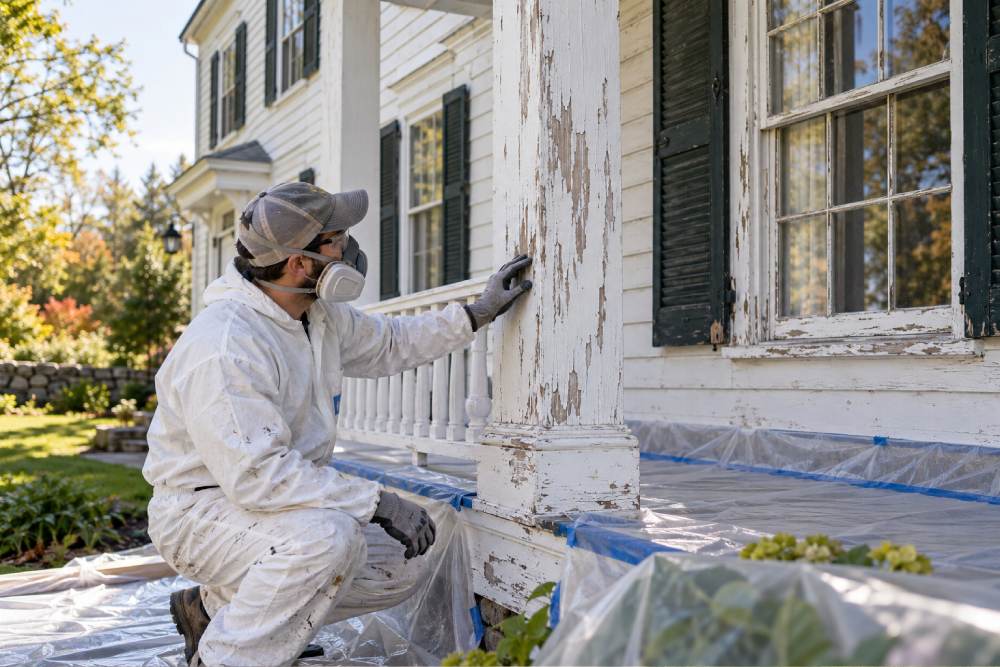
The EPA’s Lead Renovation, Repair and Painting (RRP) Rule, in effect since April 2010, requires any paid contractor disturbing lead-based paint in a pre-1978 home to be certified by the EPA (or an EPA-authorized state program) and follow specific lead-safe work practices. The rule applies whenever a project disturbs more than 6 square feet of painted surface on an interior wall or more than 20 square feet on an exterior surface — thresholds that most full-scale painting projects will exceed. Certified contractors must use practices like plastic containment around the work area, HEPA-filtered vacuums, and wet cleanup methods, and provide homeowners with the EPA’s “Renovate Right” pamphlet before work begins.
Homeowners doing work on their own home generally aren’t covered by the rule, but anyone hiring a paid contractor to work on a pre-1978 home is entitled to — and should expect — lead-safe work practices.
Connecticut’s Additional Layer of Requirements
Connecticut distinguishes between two related but separate categories of work: RRP-covered renovation and repair, which requires the standard 8-hour EPA-approved Renovator training and firm certification, and formal lead abatement, intended to permanently remove lead hazards, which requires far more extensive Connecticut Department of Public Health licensure — including 40 hours of Lead Abatement Supervisor training and 32 hours of Lead Abatement Worker training for staff. If your Suffield home has failing, chipping, or deteriorating paint rather than a straightforward repaint, ask a contractor which category your project falls into.
The Health Stakes
The RRP Rule exists because lead dust and paint chips generated during routine renovation and painting work can pose a real health risk, especially to children. According to the EPA, lead exposure has been linked to behavior problems, learning disabilities, lowered IQ, developmental delays, and a range of other health effects, particularly in kids under six. Simple activities like sanding old trim or scraping peeling exterior paint can generate lead dust that settles into soil, HVAC systems, and household surfaces if the work isn’t properly contained.
What to Ask Before You Hire a Painter for an Older Suffield Home
- Ask to see the contractor’s EPA (or CT DPH-authorized) RRP firm certification.
- Ask whether the specific crew members on-site hold individual Certified Renovator credentials.
- Ask what containment methods they will use —plastic sheeting, sealed work areas, HEPA vacuums.
- Ask how surfaces will be tested, or whether the project will proceed under the assumption of lead-based paint.
- Ask for documentation, including confirmation that you received the EPA’s “Renovate Right” pamphlet.
What This Looks Like for a Typical Repaint Project
For most Suffield homeowners, the RRP Rule doesn’t mean a project becomes dramatically more complicated — it means a few additional steps become part of a normal, well-run job: containing the work area with plastic sheeting, using wet sanding or HEPA-vacuum sanding instead of dry sanding, bagging and disposing of paint chips and dust properly, and doing a thorough final cleanup verification before the area is considered finished. On a straightforward repaint where the existing paint is intact rather than failing, these steps add relatively little time. On a home with significant peeling or bare wood exposure — more common on neglected exteriors or homes that haven’t been painted in a decade or more — the added prep and containment work can meaningfully extend the timeline, which is worth discussing with a contractor before a project starts.
Why Bengston Painting Services
Because so much of Suffield’s housing stock — inside and outside the historic district — predates 1978, working carefully around older paint layers is simply part of doing business here. Bengston Painting Services serves homeowners throughout Suffield, Enfield, Windsor Locks, East Granby, Granby, Windsor, and Southwick, Massachusetts, and takes the time to walk older-home clients through what a project will involve before work begins — including what questions are worth asking about lead-safe practices for any home built before 1978.
Have an older Suffield home and questions about your next paint project? Contact Bengston Painting Services to talk through what your home may need.
Frequently Asked Questions
How do I know if my Suffield home has lead paint?
If it was built before 1978, the EPA advises assuming it contains lead-based paint unless a certified inspector tests and confirms otherwise. This applies to most homes in and around Suffield’s historic Main Street district.
Does the lead paint rule apply if I paint my own house?
Generally, no — the EPA’s RRP Rule applies to paid contractors, not homeowners working on their own residence. That said, lead-safe practices are still a good idea for anyone’s health and safety.
What happens if a contractor doesn’t follow lead-safe practices on a pre-1978 home?
Contractors who violate the RRP Rule can face significant EPA fines. More importantly, unsafe practices can spread lead dust throughout a home, creating a hazard that’s far more costly and disruptive to remediate than following proper procedures from the start.
Is lead paint testing required before every painting project?
Not necessarily — contractors can assume lead-based paint is present and follow lead-safe practices throughout, or have a certified inspector test the home to rule it out.
What’s the difference between RRP and lead abatement in Connecticut?
RRP covers standard renovation, repair, and painting work that may disturb lead paint. Abatement is a more intensive process aimed at permanently removing lead hazards and requires separate, more extensive Connecticut Department of Public Health licensure.
Sources
- U.S. EPA — “Lead Renovation, Repair and Painting Program Rules” — https://www.epa.gov/lead/lead-renovation-repair-and-painting-program-rules
- EPA’s Renovation, Repair and Painting Rule Fact Sheet (Connecticut-specific RRP vs. abatement requirements) — https://remotesupport.luc.edu/media/lucedu/environmentalservices/pdfs/EPA’s%20Renovation,%20Repair%20and%20Painting%20Rule%20Fact%20Sheet.pdf
- Wikipedia — “Suffield Historic District” — https://en.wikipedia.org/wiki/Suffield_Historic_District
- Connecticut State Historic Preservation Office — Suffield Historic District National Register nomination materials — https://portal.ct.gov/-/media/decd/historic-preservation/06_about_shpo/state-review-board/2022-meetings/june-17/agenda-item-b_suffield-hd-nr.pdf