If you’ve started collecting quotes for a paint job in Suffield, you’ve probably noticed the numbers are all over the place — one estimate comes in under $2,000 while another tops $9,000 for what sounds like a similar job. That’s normal. Painting costs depend on square footage, prep work, paint quality, and the home’s age and architecture, and Suffield’s mix of colonial-era Main Street houses and newer neighborhoods off Route 75 and Route 159 means local pricing can span a wider range than national averages suggest. Below is a breakdown of current 2026 pricing data, the local factors that push costs up or down, and how to budget realistically before you call a painter.
What It Costs to Paint a House Nationally in 2026
According to 2026 data from Angi, the average homeowner spends about $2,021 on an interior painting project, with most projects falling between $967 and $3,076. That works out to roughly $2 to $6 per square foot, depending on whether the quote covers walls only or also includes trim, doors, and ceilings. Exterior painting costs more: NerdWallet reports a national average of $3,177, with a typical range of $1,800 to $4,500, or about $1.50 to $4 per square foot. A full exterior repaint on a larger or multi-story home can climb past $10,000 once siding type, height, and prep work are factored in, based on cost breakdowns published by Resident.com.
Interior Painting Costs by Home Size
| Home Size | Estimated Interior Cost |
| 1,000 sq ft | $2,000 – $6,000 |
| 1,500 sq ft | $3,000 – $9,000 |
| 2,000 sq ft | $4,000 – $12,000 |
| 2,500 sq ft | $5,000 – $15,000 |
Figures reflect 2026 national averages compiled by Angi and HomeAdvisor. Always check local Connecticut quotes against your home’s specific layout and condition.
What Makes Suffield and North-Central Connecticut Different
Suffield isn’t a typical subdivision town. Settled in 1670 and incorporated in 1682, the town center includes the Suffield Historic District—a roughly 235-acre stretch of North and South Main Street listed on the National Register of Historic Places since 1979 —with colonial, Greek Revival, and Late Victorian homes dating to the 18th and 19th centuries. Homes of this age typically have real wood clapboard, built-up trim, multiple window sashes, and layers of old paint — all of which add labor time compared to a vinyl-sided colonial built in the 1990s.
Age matters for another reason too: the EPA assumes any home built before 1978 contains lead-based paint, which means extra precautions — and sometimes extra cost — are required any time more than a small area of paint is disturbed. We cover exactly what that means for Suffield homeowners in a separate guide, but it’s worth budgeting for if your home falls into this category.
On the newer end, Suffield’s more recently built neighborhoods tend to have simpler trim profiles and vinyl or fiber-cement siding, which prep faster and generally lowers the per-square-foot cost compared to historic-district homes.
Interior vs. Exterior: Where the Money Actually Goes
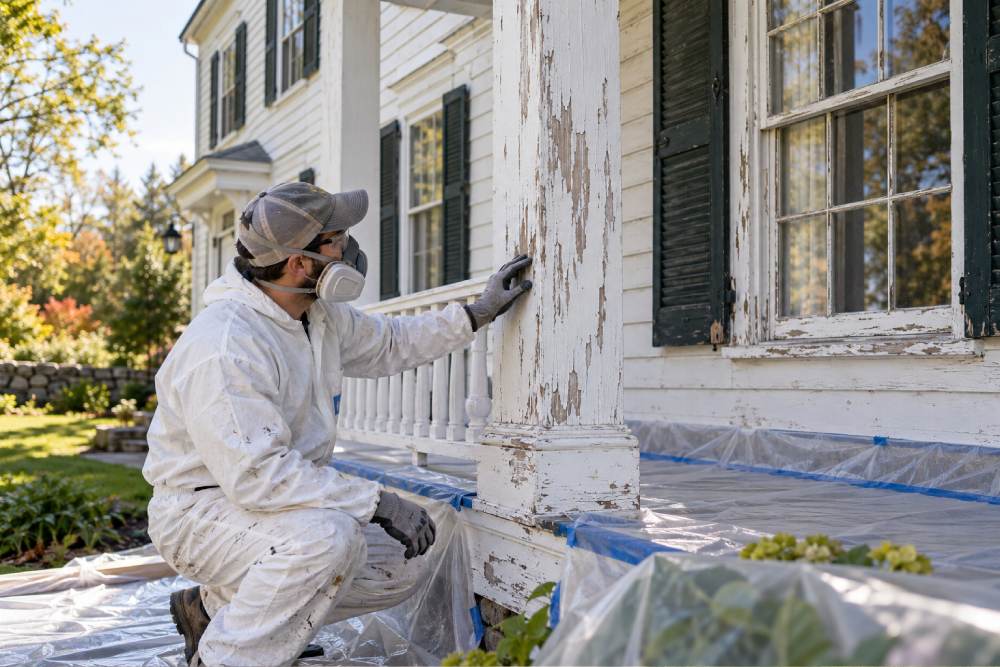
Interior quotes are driven mostly by square footage, ceiling height, and how many surfaces beyond the walls are included — trim, doors, and ceilings each add labor. Exterior quotes are driven more by prep: scraping and sanding failing paint, priming bare wood, caulking gaps, and power washing before the first coat. On an older Suffield home, prep can account for a large share of the total exterior bill, which is one reason two houses of similar size can come back with very different quotes.
DIY vs. Hiring a Professional
DIY painting looks cheaper on paper, but the full cost adds up fast once you count paint, primer, brushes, rollers, tape, drop cloths, and ladder or scaffolding rental — plus the time investment, according to cost analysis from Upstart. For a single accent wall or small room, DIY can make sense. For a full exterior repaint on a two- or three-story historic home, professional crews bring the equipment, insurance, and experience with older wood surfaces that make the investment worthwhile.
Ways to Manage Costs Without Cutting Corners
A few strategies can meaningfully lower your total without sacrificing quality: bundling interior and exterior work into one project often reduces mobilization costs, and scheduling exterior work during shoulder seasons — spring or fall — can mean better crew availability. For interior projects, tackling one or two rooms at a time rather than the whole house at once can also ease the budget if timing allows. What you shouldn’t cut is prep work: skipping scraping, sanding, or priming on an older home is one of the most common causes of paint failure within a year or two, according to painting industry cost guides.
Why Bengston Painting Services
Bengston Painting Services is based right in Suffield and works throughout Enfield, Windsor Locks, East Granby, Granby, Windsor, and Southwick, Massachusetts — so estimates are built around the housing stock our team sees every week, not a generic national average. That means a straightforward, itemized quote that reflects whether your home is a 19th-century Main Street colonial or a newer build off I-91, what prep work is actually needed, and what it takes to get a lasting result in Connecticut’s climate.
Ready for a quote that’s based on your home, not a national average? Contact Bengston Painting Services for a detailed, itemized estimate.
Frequently Asked Questions
How much does it cost to paint a 2,000-square-foot house in Suffield?
Based on 2026 national averages from Angi and HomeAdvisor, an interior repaint of a 2,000-square-foot home typically runs $4,000 to $12,000, while a full exterior repaint averages just over $3,000 to $10,000+ depending on siding type, stories, and prep needs. Older Suffield homes with wood clapboard and trim tend to land toward the higher end.
Is it more expensive to paint the interior or exterior of a house?
Nationally, exterior painting averages more per project ($3,177) than interior painting ($2,021), according to Angi and NerdWallet data, mainly because exterior work requires more prep—scraping, sanding, priming, and caulking—before paint is applied.
Do older homes in Suffield’s Historic District cost more to paint?
Generally, yes. Homes built in the 18th and 19th centuries often have real wood siding and trim, layers of old paint, and more architectural detail, all of which add labor. Homes built before 1978 may also require lead-safe work practices under EPA regulations, which can increase costs.
What’s typically included in a professional painting quote?
A detailed quote should specify surface prep (scraping, sanding, caulking, priming), the number of coats, paint brand and sheen, and exactly which surfaces are covered — walls only, or walls, trim, doors, and ceilings.
How often should I repaint my house in Connecticut?
Interior paint typically lasts 5 to 10 years depending on the room and use. Exterior paint in New England’s freeze-thaw climate generally needs attention every 5 to 8 years, though a well-prepped, high-quality job can last longer.
Does painting a house increase its resale value?
Exterior improvements consistently rank among the highest-return home projects, according to Remodeling’s Cost vs. Value data. We break down the research specific to Suffield’s housing market in our article on exterior painting and home value.
Sources
- Angi / HomeAdvisor — “How Much Does It Cost to Paint the Interior of a House?” — https://www.homeadvisor.com/cost/painting/paint-a-home-interior/
- NerdWallet — “Cost to Paint a House in 2026 — Plus 6 Ways to Save” — https://www.nerdwallet.com/home-ownership/home-improvement/learn/save-on-cost-to-paint-a-house
- Resident.com — “How Much to Paint a House in 2026? A Homeowner’s Cost Guide” — https://resident.com/resource-guide/2026/02/05/how-much-to-paint-a-house-in-2026-a-homeowners-cost-guide-for-professional-painting-and-construction-projects
- Upstart — “The Average Cost to Paint a House in 2025” — https://www.upstart.com/learn/cost-to-paint-a-house/
- Wikipedia — “Suffield Historic District” — https://en.wikipedia.org/wiki/Suffield_Historic_District